Pakistan is a country of suni-sunai history: someone mouths some silly banality prefixing it with a weighty-sounding, ‘In 315 BCE…’ and all within earshot gobble it up as gospel. No one bothers to counter-check. The result is that fools and charlatans have become our most respected historians and the plethora of worthless television channels has turned these wafflers into national icons.
 |
| A cluster of ruined elaborately-carved sandstone tombs at Aghor |
End result: most people, even those supposedly educated, know no history. They only memorise tripe they think is history. For the past decade or so, I have written several times on the route
Mohammad bin Qasim took into the subcontinent and the way he exited under arrest to be imprisoned in Iraq and die there in ignominy.
Labels: Alexander, History, Makran Coastal Highway, Sindh, TNS
posted by Salman Rashid @ 00:00,
,

Fahd was tall, I never asked him how tall, and he was well-built and good-looking. To go with that brawn was a very sharp, active mind that gave him an interest in everything around him. He was an electronics engineer and also had some sort of qualification in finance. Our extended family met him when my niece Maria and he were interns with a bank back in 2003 or thereabouts. (Or, were they already working as bank officers?)
 |
| There was nothing make-believe about him |
Fahd was the kind of person you would immediately like. With his ready grin and merry laughter, he was the fun chap always a treat to have around, and he simply grew on you.
Read more »Labels: People, TNS
posted by Salman Rashid @ 00:00,
,
Some years ago, having seen a lovely pipal fronting an empty plot near a friend’s home, I would carry on about the beauty of the tree. The tree stood their magnificent, gorging itself on atmospheric carbon dioxide; holding the carbon in its body to reduce global warming, it spewed out pure, unadulterated oxygen so that no life on earth may die of asphyxiation. The plot being unoccupied, the tree had been there undisturbed for decades.
 |
| The tree on the highroad south from Jalandhar to Ughi |
But then my friend told me the plot had been purchased by some yahoo who was going to build a home on it. I said I would bet my last rupee that the first thing that foolish buyer would do is to chop down the tree.
Read more »Labels: Ecology, TNS
posted by Salman Rashid @ 00:00,
,
The edifice is unpretentious. But the quality of construction is superior. So fine, in fact, that the building could only have been built for nobility. Nadia, my hostess in Palandri (Kashmir), said it was called baoli – the traditional subcontinental well with steps descending to water level – and I imagined a structure like the Mughals were so fond of building.
 |
| School in progress in the Rani’s Baoli. The rani’s room is in the background with the utility rooms on right |
As I was driven a few kilometres outside Palandri town, Nadia told me the building is believed to have been a watering place for the animals of passing caravans and nothing more. When we arrived, the fine architecture immediately told me that the structure was much more than what they believed it to be. Ell-shaped with the rooms fronting an open courtyard formed by a low wall on two sides, the building comprises six rooms of various sizes.
Read more »Labels: Heritage, Kashmir, Kashmir Diaries, TNS
posted by Salman Rashid @ 00:00,
,
Twenty years ago I spent a couple of days with my army chum Ahmed Yar Bandial in his village which is, naturally, Bandial. It sits on the old highroad from Khushab to Mianwali. For good measure, it keeps company with village Hadali, famous for being the ancestral place of the great Khushwant Singh. Incidentally, upon his passing, our very own Fakir Syed Aijazuddin brought home the ashes of the great writer to inter them in one wall of the school where this future luminary first learned the secrets of the written word.
 |
| The well: Rising just above the mesquite trees in the back can be seen the domed pillars marking the head of the steps leading into the well |
But all this was just to get the geography right.
Read more »Labels: Heritage, Punjab, TNS
posted by Salman Rashid @ 00:00,
,
It could have been a day warm and humid as it was in August 1553 when Kamran Mirza’s eyes last beheld the crenulated walls of Pharwala Fort starkly outlined against a blue Bhadon sky held up by billowing white cumulus. But it was crisply warm as we parked on flat ground above the Soan River running between us and the fort.
 |
| Hathi Gate |
It had started out with
Rehan Afzal and I talking about Pharwala. But then Pharanaz and her husband Naweed joined us too and we resolved to together visit it. Returning to the fort after eighteen years, I had forgotten that I had then entered by Hathi Gate by wading across the river, the same way as Babur had done back in the spring of 1519. There, behind the fortification Babur espied the steely gaze of Hathi Gakkhar, a man of gigantic stature and reportedly superhuman strength that likened him as to an elephant.
Labels: Heritage, History, Punjab, TNS
posted by Salman Rashid @ 00:00,
,
My good friend
Murtaza Solangi spent some of his long journalistic years in Washington DC. There, he says, he waited through those harsh winters for the cherry blossom to break out on the borders of the lake or pond or whatever that body of water is. He asked me if I had ever seen it, but the nearest I’ve been to DC was when I was briefly in New York three decades ago. It is in May, says Murtaza, that they have their Cherry Blossom Festival, a great binge of gaiety, song, dance, food and drink.
Murtaza says that these trees were gifted to DC by the Japanese emperor at the end of World War I. This is not the fruit-bearing species, just the flowering one and its sole purpose is to bring beauty and colour to the landscape. The Japanese have long had the original cherry blossom festival and when I checked Google, I discovered that several US and Canadian cities now follow the Washington DC model.
Read more »Labels: Ecology, TNS
posted by Salman Rashid @ 00:00,
,
The past truly is another country. Inspired by Paul Theroux’s classic in travel literature The Great Railway Bazaar, I endeavoured to execute a Little Railway Bazaar. And so I embarked upon a series of train journeys in Pakistan. I rode the narrow gauge train from Bannu to Mari Indus; the metre gauge from Nawabshah to Mirpur Khas and from the latter place to Khokhropar on the Indian border. I thrilled to the several crossings of the Nari River by those magnificent steel spans a century old at that time; and I beat the furnace wind of the desert plains of Dalbandin by a mere fortnight when I rode the Lonely Line to the Iranian frontier.
 |
| Where the Jalu jo Chaunro station once stood |
The fat, pot-bellied Ticket Examiner mentioned the name of the wind: bad e sad o bees roz – Wind of a Hundred and Twenty Days – and my flesh crawled. This was a sound from tales a thousand years old. Tales in which bells jangled as camels plodded through the dunes of this beautiful land of Balochistan; tales that told of caravanserais so remote that even today one has difficulty reaching their ruined walls. These were tales handed down around fires on freezing desert nights and preserved through the generations. Today, the wind still blows but train conductors no longer refer to it as the
bad e sad o bees roz. A fascinating piece of tradition is forgotten.
That was in 1986-87. That is more than a quarter century in the past. That was another country.
Read more »Labels: Pakistan Railways, Railway, Sindh, TNS
posted by Salman Rashid @ 00:00,
,
A rather scenic and winding tarmac road connects
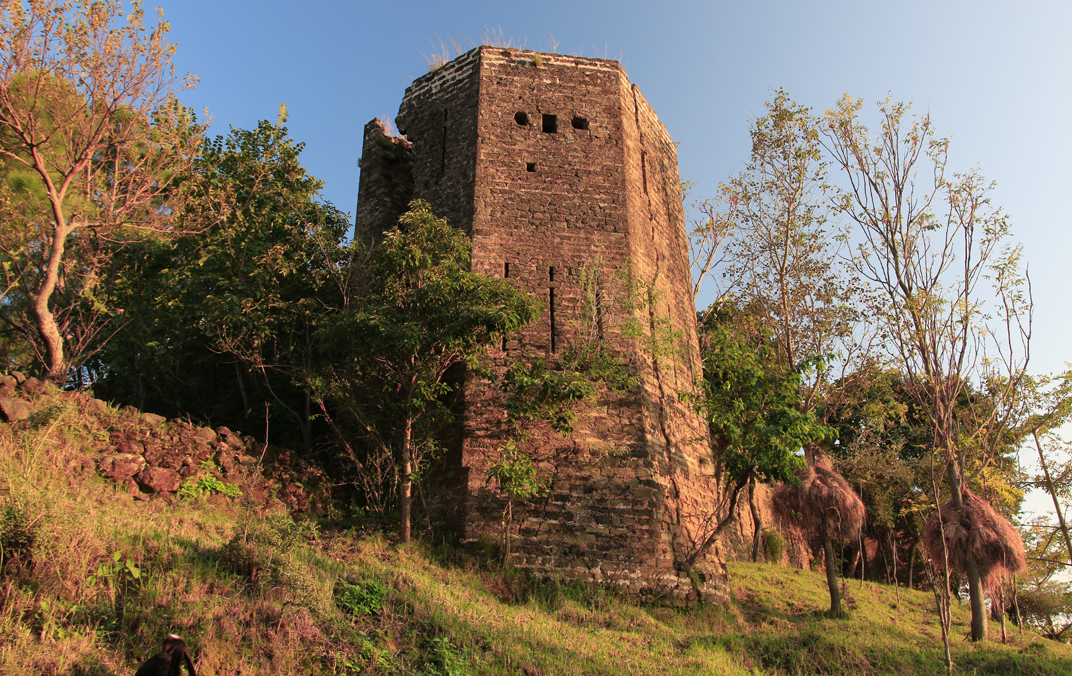
Palandri with Baral (pronounced Baa-Rull), 50 minutes away due south. Baral has not much to show for itself but 20 minutes south of the clump of houses there sits on a low eminence a tiny fort taking its name from the village.
A view of the exterior
Shaped like a fisted hand with a stubby thumb sticking out to one side, it is tiny — measuring no more than 40 to 50 square metres; the fisted hand being its square plan and the thumb its entrance portico. The corner turrets are octagonal and I at once recalled the forts of
Muzaffarabad, Ramkot, Baghsar (near Bhimber) and Mangla — Baral and all these were apparently built from the same template.
Labels: Heritage, Kashmir, Punjab, TNS
posted by Salman Rashid @ 00:00,
,
Zafar Abbas Naqvi is quite a remarkable man — there are scarcely any police inspectors in Pakistan avidly pursuing intellectual interests. And he happens to be one. It is evident that the man was a keen traveller and observer even as a young and impressionable student. His freewheeling may have been curtailed in a small way by his joining of the service in 1997 but that still did not curb his spirit of inquiry.
Over the years he thereby built up a large repertoire of travel tales and anecdotes. Add to this a sharp observation of what he sees on the way. From the mundane to the extraordinary natural or built object to stories related by locals Naqvi imbibes all with enthusiasm. Best of all he couples his folk knowledge with a reasonable dash of research.
Read more »Labels: Book Review, Books, Punjab, TNS
posted by Salman Rashid @ 00:00,
,
‘I am now about to die.’ (Main hun murn vala aan.) Qadir Buksh who, more than two decades ago, would pronounce his name Bushk, said in a wheezing squeaky voice. It was not a sad plaint; it was a statement of an imminent event. It was as if one would squint skyward on a dull day and say, ‘It’s about to rain.’
Qadir’s utterance destroyed me inside. I had come to talk to him of days gone by; of the glory days of the Indus Queen when he captained that beautiful river boat. I had wanted to tell him of the lie I had then told knowing full well he would never read the piece I would write. I had imagined we would together remember those far off days and laugh. And perhaps even shed a tear or two at the fate of the Queen. In my mind’s eye I saw the man still as he was then in his forties with the same thick mop of tousled black hair and a heavy walrus moustache in his coloured laacha and white kurta. On his feet he had finely worked khussas that were all the worse for wear.
Read more »Labels: Ferry, People, TNS
posted by Salman Rashid @ 00:00,
,
It was the week before the end of the month of fasting when PIA told me there were no seats on the Chitral flight until August 19. I said fine, I’ll take one on the following day. They said, sorry. There had been a mistake and there were actually no seats until September 26.
Back in September 2010, I needed to fly to Chitral 10 days after eid. I was told I could not until six weeks later. I knew this was a lie: it was the end of summer, there were no tourists headed to Chitral and there was no way planes could be flying full. I requested my friend Khalid Shameem Wynne’s help. I got the in and out seat ‘on the Ministry of Defence quota’ and flew.
Read more »Labels: Chitral, Khyber-Pukhtunkhwa, TNS
posted by Salman Rashid @ 00:00,
,
When they first saw this beautiful land they called it Shubhavastu — the Good (or Fertile) Land. Stand atop the hill of Brikot just after you have descended into the Swat Valley from Malakand Pass and gaze northward. There, spreading below you is a broad flood plain with the Swat River braided across it in two or three streams with islands between them and on either bank neatly parcelled squares of cultivation, and you know that the Sanskrit speakers were on the ball. Fertilised by the perennial river, this is the Good Land.
In the vernacular, Shubhavastu became Suvastu with the initial ‘su’ meaning ‘good’. When Alexander and his legions came hither in the latter part of the 4th century BCE, they altered the name according to their own usage. The Shubhavastu of the learned man and the Suvastu of the farmer who worked its fertile breast became Soastos on Western tongues. Thence it was a short journey for the valley and its river to be called Swat.
Read more »Labels: Swat, TNS
posted by Salman Rashid @ 00:00,
,
Back on the road beyond the mud volcano, the blacktop shortly gave way to a shingle road-bed. But even this had been prepared well and we carried on without reducing speed. Presently we were on the banks of the Hingol River. Rising in the hills near Nal, west of Khuzdar, and known as Nal in its upper reaches, the Hingol cuts a most dramatic gorge. Here, a few kilometres above its mouth, it is languid and green with silt. Together with the image of the mud volcano, etched from my earlier trip was one of the Hingol with its Tamarisk-shaded banks. But I was disappointed. The thick growth on its sides had given way to saplings. As the building of the Karakorum Highway had deprived the Indus gorge of its thickets of holly oaks, so too the
Coastal Highway has eaten up the Tamarisk of the Hingol valley – all gone up in smoke.
 |
| The temple sacred to Nania or Ishtar, to Durga Ma and to Bibi Nani |
We had been talking of the crocodiles of Hingol and suddenly Marvin pointed to the far bank and said, ‘There’s one now.’ I looked hard and to me it seemed to be a log. We stopped, got out of the jeep and stared. The log remained static. Then two huge dump trucks came thundering down the road and their noise animated the log. It slithered into the green water; half submerged and became immobile again. Shortly after I spotted another swimming languidly in mid-stream. And then another. The Hingol lives. Strangely enough, we also saw a man bathing and washing about two hundred metres upstream with complete disregard for the crocs. And then we saw another man wading unhurriedly across the river. The croc on the bank was no less than two metres long and could badly maul a grown man, yet these fatalists were going about their business evidently without a worry. Perhaps they knew a satiated crocodile from a hungry one. Either that, or they were privy to feeding schedules.
Read more »Labels: Balochistan, TNS
posted by Salman Rashid @ 00:00,
,
A lesser woman in remote Seejbun in Swat’s Matta sub-division would have given up. In fact, she would have been born resigned to the usual fate of domestic confinement and a long, inconsequential life. That, so she was always told, was Pakhtun culture. Part of this baggage was also to be wedded as soon as she attained puberty. That was the way for the young women in Seejbun.
But Gul Khandana was born different. After she finished primary school in the only girls’ school miles away from her village, the pressure from uncles and older cousins was for her to be restricted to the home. Fortunately, she had a brother younger than her and unable to exert pressure. She also enjoyed her father’s support and was thus able to join the local boys’ high school to complete her middle level education at age 17. Still a long way to being educated, Gul resolved to become a teacher.
Read more »Labels: Khyber-Pukhtunkhwa, People, Swat, TNS
posted by Salman Rashid @ 00:00,
,
On March 13, a group of nine Balti mountaineers and a doctor set out of Hushe (north of Khaplu) on a trek of 1000km, carrying with them a message of peace for the world.
Through Skardu, Gilgit and by way of the
Karakoram Highway, they reached Islamabad exactly 31 days later.
These good men were set off by the irresponsibility of the country’s print and electronic media. The semi-educated and irresponsible journalists manning the media cannot differentiate between the northwest of the country and what was until some years ago Northern Areas and routinely reported about terrorism emanating from the ‘Northern Areas’ (shumali ilaqajat in Urdu). The result was widespread vilification of the Gilgit-Baltistan region as a terrorist hotbed. And this was not just among ignorant Pakistanis but equally ignorant foreigners as well.
Read more »Labels: Gilgit–Baltistan, Northern Pakistan, Pakistan, People, TNS
posted by Salman Rashid @ 00:00,
,
My friend Aziz Jamali is a hard task master. Standing orders for the four days Akmal and I spent with him in
Awaran were: out of the house at 6:30 AM – without breakfast too. This only helped make huge appetites for lunch and that was just as well for the fare was always premium. His full mop of silver hair gives a deceptive look to his youthful face, and I cannot even venture a guess as to his age. But as a trekker of some experience, he was the fittest in our trio who seemed unfazed by early morning hard work on an empty stomach.
Aziz Jamali and a levies man examine the bubbling mud at close quarters.
As deputy commissioner Awaran, Aziz has been almost everywhere. Whenever he can take time out from rebuilding the poor earthquake-ravaged district, he goes exploring. Among other little or even unknown items, he has discovered a number of mud volcanoes in his district. Now, having read of these natural curiosities in early 19th century works of British explorers, I was also acquainted with the set of three that lies on the seaboard just south of
Makran Coastal Highway in Lasbela district a few kilometres from the fishing village of Sapat Bunder.
Labels: Balochistan, TNS, Volcanoes
posted by Salman Rashid @ 10:55,
,
P. S. A. Berridge, a Bridge Superintendent with whom my father worked as a young Assistant Engineer on the North Western Railway in pre-partition India, wrote a very readable account of this railway network. The book, titled Couplings to the Khyber, has long been my bible. Unfortunately, out of print in Britain there are only a few copies of this book to be found in Pakistan; one in the Railway Headquarters of Lahore and the other in the library of the Department of Archaeology at Karachi.
The destroyed bridge at Tanduri
Berridge notes that the story of the construction of the line to Quetta has ‘no parallel in the whole of the history of the railways in India.’ Among other things, he tells us, it was the exemplary courage and fortitude of the engineers and ordinary labourers against not just the elements but recalcitrant and depredatory Marri tribesmen, that was most admirable and which made the laying of line possible.
Read more »Labels: Balochistan, Railway, TNS
posted by Salman Rashid @ 01:00,
,
(This journey was undertaken in August 2002. This two-part story appeared in September that year in The News on Sunday)
‘May there be peace between India and Pakistan,’ Marvin intoned solemnly as he finished building his little cairn. ‘Forever,’ he added as an afterthought. ‘Amen!’ I said under my breath.
 |
| From the lip of the dead crater looking out to the tall active mud volcano. The third is just visible on the horizon to the right of the high cone |
We were standing where the cone of the mud volcano began to rise above the featureless sandy plain and it was only on our way back from the top that Marvin had noticed the hundreds of little cairns sprinkled all around. We did not know what the cairns meant, nor did I remember reading anywhere about a cairn-building ritual connected with the worship at the mud volcano en route to the
Hinglaj pilgrimage. Perhaps this was part of the ritual or simply a sort of signature to record a passing devotee’s visit. In the spirit of good pilgrims we built our cairns and prayed for peace to be given a chance.
Labels: Balochistan, TNS, Volcanoes
posted by Salman Rashid @ 00:00,
,
The traditional melas — fairs — in the subcontinent were the place for ordinary folks to let their hair down. Long before they took on a quasi-religious colour in Muslim Pakistan, fairs were secular whose timing was guided by the seasons.
Harvests meant food in the larder and cash in the pocket and so we had festivals in April and May, coinciding with the wheat harvest alternating with those to mark the cutting of rice and sugarcane.
Things changed and while some many
festivals became aligned with the lunar calendar, some despite their attachment to shrines and death anniversaries of the saints interred therein continued to stick to the earlier solar calendar.
Labels: Culture, Festivals, TNS
posted by Salman Rashid @ 13:28,
,