I first saw this fabled hilltop fort in 1989. It sits above the village of Mari, some 40 kms north of Mianwali and overlooks to the west, on the far bank of the Indus, the picturesque riverside town of Kukranwali.
The Mianwali district gazetteer of 1915 noted it was known as Maniot, corrupted from Manikot, signifying ‘Fort of Jewels’. This, the gazetteer recorded, was because the ‘Kalabagh diamonds’ were found here. Whatever these diamonds were, no one could tell me then nor on a recent visit.
Read more »Labels: Heritage, Punjab, Sindh
posted by Salman Rashid @ 13:08,
,

A nthropologist Zulfiqar Ali Kalhoro is working in overdrive. Taking time off from his teaching assignment at Quaid-i-Azam University, Islamabad, this young and gifted researcher seems to be forever on the move in the wild regions of Pakistan.
His work is genuine, without shortcuts in his fieldwork and research methods, and the result — whether in his frequent newspaper articles or his books — is primary material for the reader interested in anthropological works. Kalhoro reminds one of the tireless and brilliant Adam Nayyar, executive director of the Pakistan National Council of the Arts who, sadly, left us too soon.
Read more »Labels: History, Sindh
posted by Salman Rashid @ 08:41,
,
Ali Bhutto Up until the early 1990s, the portion of the Thar Desert that lies within Pakistan was largely devoid of blacktop roads, with the nearest one ending at the desert’s western periphery in Naukot. All travel from this point onwards was done either by camel, vintage Reo trucks from the Second World War — locally referred to as kekrra [crab] — or privately owned jeeps.
Back then, the journey from Naukot to Nagarparkar, which lies at the easternmost edge of Tharparkar district — today, a five-hour drive — would take up to 14 hours, writes Salman Rashid in his new book, Mithi: Whispers in the Sand.
Read more »Labels: Book Review, Books, Salman Rashid, Sindh
posted by Salman Rashid @ 10:49,
,
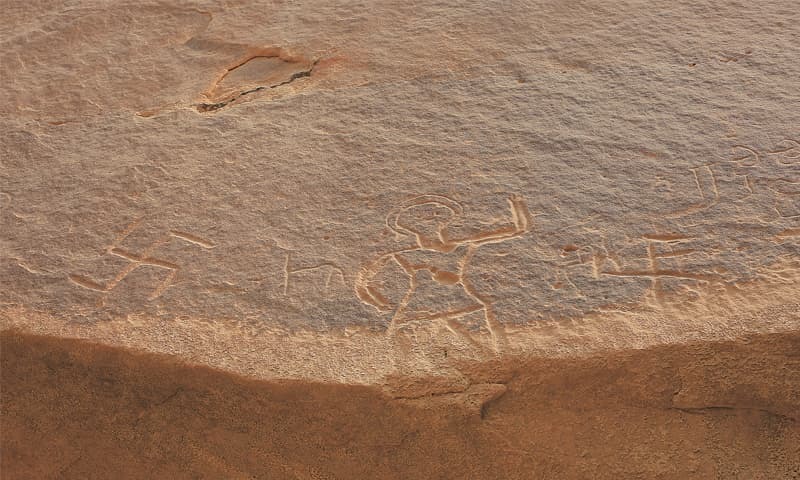
In February 1987, trekking up to the source of the Hub River in Balochistan, I had my first exposure to ancient rock art. Etched on a rock, in a wild and desolate area north of the village of Goth Badal Khan, was a hunting scene.
Dismissing those drawings of men, animals and geometric symbols as the work of modern youngsters, I took no further notice of them. Such was my understanding of our local petroglyphs, even when I erroneously considered myself an informed layperson.
Those etchings on stone were in the vicinity of what the locals call a gabr band — or wall of the fire-worshippers. Scores of these walls of dressed stones are scattered around in the mountainous areas northward of Balochistan and Sindh from the 26th parallel latitude.
Read more »Labels: Book Review, Books, Sindh
posted by Salman Rashid @ 09:30,
,
In 2017, the district administration of Tharparkar at Mithi invited me to this work. Through that year, I made five trips to Mithi at different times of year. Though I was under the mistaken notion that my research was complete, when I got down to writing, I found so much was missing. Spent the whole of 2018 reading and writing. Last year, 2019, was spent in editing. Very slow process that was. Over the past two months young Aamir Ali designed this work with great love and attention.
Labels: Books, Sindh
posted by Salman Rashid @ 21:00,
,
Badar Abro, author of Ranikot: The Wall of Sindh, is without a doubt the one individual who has seen every inch of the Rannikot Fort. And he has seen, nay, observed it with a critical and learned eye. From his first trip out to this great monument in 1985, he has never been there as a tourist; he has always been a researcher. With remarkable and dogged commitment, he has returned repeatedly to that harsh environment. That alone is an achievement and some. He is therefore well equipped to write on Rannikot.
The book, so grossly mistitled Ranikot, is a beautiful presentation with scores of first-class ground level and drone images and maps. The latter are a great help to elucidate the layout of this spectacular fort. I have long held that Sindhis are a people who have a strong umbilical cord harnessing them to their dharti [land], so the corruption of a place name by a true Sindhi is therefore not just jarring, but heartbreaking for me.
Read more »Labels: Book Review, Books, Sindh
posted by Salman Rashid @ 10:43,
,
"The Kirthar Mountain Range, which separates Sindh from Balochistan, is rich in ancient petroglyphs.” Thus anthropologist Zulfiqar Ali Kalhoro opens his latest book Symbols in Stone: The Rock Art of Sindh. If anything, this is an understatement, because in Sindh, virtually thousands of examples of man’s artistic expression can be found. In two earlier works, Kalhoro discussed memorial stones and funerary architecture and its art in the province. In this book, as indeed in his earlier works, the author unravels aspects of anthropology and history that had always been right in front of our eyes and of which we knew nothing.
Until the book on memorial stones in Tharparkar, even the informed traveller coming upon them was utterly uninformed of their provenance and meaning. The Brahmi script on the oldest memorials, and Gujarati on later ones, was unknown to visitors and so these stelae — whose exact number was not known — sprinkled around the Thar Desert were just stones with nice carvings of horse riders. End of story.
Read more »Labels: Book Review, Books, Sindh
posted by Salman Rashid @ 10:05,
,
In a word,
Rannikot (pronounced ‘Runny Coat’ and not ‘Rani Kot’) is an enigma. And that is because medieval history makes no mention of such a magnificent undertaking. As for the name, that comes from the seasonal Ranni stream flowing through it and not from some rani.
Approaching it from the east via Sann village in Jamshoro district in Sindh, one cannot but remark on the resemblance of its fortification to the Great Wall of China. The ramparts, interspersed with stout turrets, dip and rise with the contours of the Lakki spur of the main Kirthar Mountains. If one were to circumambulate the fortification one would see how the builders incorporated the lay of the hills into the defensive scheme: where the hills are sheer and difficult to scale as in the northwest and northern corner, there are no ramparts. In this area of difficult access, there are only watch towers.
Read more »Labels: Heritage, Sindh
posted by Salman Rashid @ 10:55,
,
The legend in Saddo Mazzo, Sindh that lives on through the ages is that of the sisters Saddo and Mazzo, princesses who ruled from a hilltop castle in the rugged and largely barren hills west of Johi (Dadu district). As their forces prepared to set out to attack a neighbouring settlement, the duo instructed the general to see that the flag was kept flying high for them to spot from their hilltop eyrie. This would tell them the proceedings were going in their favour.
 |
| The Dancing Girl of Saddo Mazzo |
Any lowering of the standard would indicate the field had been lost. Then, in keeping with true Rajput tradition, the princesses were to fling themselves off the lofty ramparts to death on the rocks below. But as the distant fray unfolded, for one brief moment, the flag was lost from sight in the dust and commotion. For the princesses this was enough sign of defeat. Both Saddo and Mazzo leapt off the castle ramparts and died even as their victorious army turned homeward.
Read more »Labels: Heritage, Sindh
posted by Salman Rashid @ 00:00,
,
The blurb on the title page of The Arabs in Sind — 712-1026 AD tells us that the work is the dissertation of John Jehangir Bede as submitted to the Department of History, University of Utah in the United States. As for Bede, the Publishers [sic] Note on Page VI begins, “All efforts to trace Mr Bede lead to a blind alley.” However, the last line of this note tells us that he was born in January 1940 to Mary and Zwingle Bede and died in 1989. Attempts to trace him through institutions he was connected with led to similar dead ends. Regardless, the work itself is rather useful and one wonders why this piece of research languished so long before being brought to light. However, thanks to the Endowment Fund Trust, Karachi, better late than never.
Bede weaves a readable and concise account of the Arab invasion of Sindh in 711 CE. His sources are many and varied and the point of interest here is that he delves deeply into the archive of Arab history dating from the eighth to the 10th centuries. In fact, the treasure trove in the book is Chapter II, titled ‘The Sources’. It forms a compendium of all source material dealing with the Arabs in Sindh.
Read more »Labels: Book Review, Books, Genealogy, History, Sindh
posted by Salman Rashid @ 00:00,
,
Over three decades ago, I saw for the first time a stele on the bank of Bhodesar pond outside Nagarparkar town in Sindh’s
Thar region. It was a time of drought. The pond was dry and an upright sandstone slab was standing there.
 |
| Courtesy Memorial Stones Thararkar |
The slab carried a beautiful carving of a horse rider, his raised left hand holding what appeared to be a staff. At his waist was a quiver bristling with arrows. In a panel immediately below the artistic rendering were a few lines of writing that I thought was in Hindi. Nearby was another slab bearing what was clearly the depiction of a woman. Her dress was notable for being quite similar to the ghagra still worn in Thar.
Read more »Labels: Herald, Heritage, Sindh, Thar
posted by Salman Rashid @ 00:00,
,
The hills – as gold-brown as sun-dried chaff, or dark grey like fire-scoured lead, rise sharply on either side of the narrow gorge. Rarely is their burnished starkness broken by vegetation; rarely, save during a downpour, does one see a trickle of water on these slopes. Desiccated, harsh and barren, the slopes run down to the pebbly bed of the Bolan River where the water flows in a narrow channel. Rarely does the entire riverbed know the feel of water sluicing over it – and that again only during a downpour.

Long, long before
Alexander the Macedonian was born; long before the Aryan hordes swept into the plains of the Sindhu-Ganga river system to give rise to a new religion and a new culture; even before the great tragic hero Gilgamesh, the king of Uruk (lower Mesopotamia), disturbed by the demise of his dearest friend, undertook his epic quest for immortality; the Bolan Gorge had resounded to the tramp of marching feet, to the clink of armoury and the jangle of camels’ bells. For this was the highroad leading west from the plains of Sindh where one of the great civilisations of prehistory flourished. The discovery of the ruins at Mehrgarh near Sibi at the lower end of the Pass and the verification that this ancient city had flourished as far back as the eighth millennium BCE testifies that the
Bolan route has certainly been used as long as that.
Read more »Labels: Balochistan, Sea Monsters and the Sun God, Sindh
posted by Salman Rashid @ 00:00,
,
Back in 1987, in my freewheeling days in Sindh, I one day found myself in village Kamaro nearly midway between Mirpur Khas and Tando Allahyar. Otherwise unremarkable, the village was known for a shrine and its adjacent mosque. But not being a believer in miracles attributed to shrines, I was there only because I had heard of the beauty of both buildings.
I was not disappointed. Compared to those humongous buildings that we generally see, these two were tiny. But the splendour of the predominantly blue tile work was exquisite. So exquisite was it, that it will not be wrong to rank the two buildings of Kamaro among the most beautiful of Sindh, so far as tile work was concerned.
Both buildings measured about seven or eight metres square and, not taking the minarets of the mosque into account, were of equal height. So far as I remember, the mausoleum did not have a dome. If it did, the flow of the patterns in blue was so smooth that one simply did not notice the dome. One was only lost in the melody of the ornamentation.
Read more »Labels: Heritage, Sindh
posted by Salman Rashid @ 00:00,
,
South of Badin (Sindh), in the heart of the Great Rann of Kutch, there is a place called Rupa Mari — Palace of Rupa. In that vast emptiness there sits a low conical mound of clay and an unpretentious grave under a timber canopy. The land around is strewn with pottery shards to remind us of a now forgotten town. They say the ruins are named after the queen of Bhongar, the second of the Soomra kings of Sindh who built the town. The grave is that of their grandson Dodo II.
Legend relates that the first Dodo had two wives: one a blacksmith’s daughter and the other a Rajput woman. The former bore the king a daughter and a son called Bhagi and Chanesar respectively. The other wife was pregnant when Dodo fell in battle, and when the child was born the aged Bhongar named him Dodo after the fallen king.
Read more »Labels: History, Sindh
posted by Salman Rashid @ 00:00,
,
Wow! This must be the Addams Family home!” I said as my friend Hameed Mallah drove through the open iron gate. It was almost 10pm, one March night in 2010 or the year after. Before us lay a brick driveway bordered on the left by a hedge that hadn’t seen a topiarist’s hand and shears in ages. Spread out on the right was an open plot that could have been a perfect flower-spangled garden around a patio.
But it wasn’t.
The creepy interior of the Sindh Irrigation Department resthouse in Sanghar
The house stood at the apex of the arc of the driveway: two-storeyed with what we call a mumti in Punjabi, at the top. In front was a car porch, its pale blue tiles offsetting the general dreariness of the building. The entire grounds [spread out with plenty of potential to convert them into beautiful gardens] bore a look of aggressive abandonment as did the house itself. Such then was the resthouse of the Sindh Irrigation Department in Sanghar.
Read more »Labels: About, Sindh
posted by Salman Rashid @ 00:00,
,
I first saw this magical place in 1987. The Saruna River (Lasbela district, Balochistan) breaks out of its narrow rocky gorge and, before going on to run into the Hub River, spreads out to form a tarn. Said to be very deep (so far as I know, no sounding has been done to determine its depth), the water is of a striking deep green shade. And the setting is so uncannily beautiful that it does cause a sharp intake of breath.
The lake teems with crocodiles. Local legend has it that one accused of theft or mendacity thrown into the water will either be taken or rejected: the guilty, so they say, will be eaten. The innocent can swim and gambol in the water even as the crocs look on unconcerned.
In 1987, there was one grave said to be that of Ari Pir along with its ancillary burials of lesser saints and one little tea shop and eatery. Ari Pir, so I learned, was a staging post on the route from Sehwan to Lahut Valley that became active in the month of Ramazan when hundreds of bhang-quaffing malangs passed through from the former to the latter. But there was no story about Ari Pir.
Read more »Labels: Balochistan, Sindh
posted by Salman Rashid @ 00:00,
,
The Kalhora dynasty ruled over Sindh for a full century from 1680 to 1783. Whereas the decline of this house of religious and military leaders owed all to inept bumblers, there were in the early years of the rise and power of this dynasty men of remarkable acumen and administrative skill who guided its fortunes.
 |
| Drigh Bala necropolis |
Many remember the Kalhoras as builders of the most elaborate irrigation system in Sindh prior to the British advent that turned vast desert regions into fertile farmland. The Kalhoras were noted also for raising the new city of Khudabad (Dadu district) and virtually rebuilding Hyderabad from scratch to give it that name after Ali (RA) the last of the rightly guided caliphs.
Read more »Labels: History, Sindh
posted by Salman Rashid @ 00:00,
,
The land around village Kabir Panhwar, a few kilometres from Johi in Dadu district, has remained unirrigated and uncultivated for centuries. Only hardy desert trees can grow in its sandy soil. Amid the prosopis and acacia, the thorny mesquite provides rich and poor alike with excellent fuelwood. The only patches of cultivation that one sees are owned by landowners who have their own tubewells. The landless of Kabir Panhwar and nearby villages can either work on the farms of the rich or, if they are free-spirited, can be wood cutters. The remarkable Laalan Khatoon used to be among the latter.

Every two or three days, Laalan would hire a donkey cart, spend the whole day hacking away at the mesquite even as the thorns cut her skin and tore her clothing to make a cartload of firewood. In Johi she would sell the load for 1,000 rupees. Paying cart rental at 200 rupees per day she would share the rest of the profit with whoever partnered with her, each person ending up with, on average, a little under 300 rupees per day.
Read more »Labels: People, Profile, Sindh
posted by Salman Rashid @ 00:00,
,
Hard by a farm-to-market road outside the village of Sahib Khan Chandio, ten kilometres north of Hyderabad and just off National Highway 5, there stands amid the fields a yellow sandstone obelisk. The white marble plaque on one of its faces tells us that the monument was ‘Erected by Major General Sir Charles Napier GCB and the officers, non-commissioned officer and soldiers of the British army under his command in memory of their comrades who fell in the battles of 17th February and 24th March 1843 fought with the Ameers of Sind.’
The plaque then lists the names of those three hundred or so British and Indian men who gave up their lives fighting for control over Sindh. Understandably, the monument commemorates the men who were in the service of the British crown, not those who fought for the independence of the country of Sindh.
Read more »Labels: History, Sindh
posted by Salman Rashid @ 00:00,
,
In the year 1902 parts of the Shikarpur and Karachi districts of the province of Sindh were carved away to establish the new district of Larkana. Long before that this area was known as Chandka after the well-established
Chandio tribe that still lives in great numbers in the western hills of the district. Now the newly established district was to get its new name from the Rajput clan of Larik.
In a paper submitted to the Government of India on 31 December 1847 Hugh James, the Deputy Collector (equivalent to the modern Assistant Commissioner) of Shikarpur, did not hesitate to call Chandka the ‘Garden of Upper Sindh.’ His reason for this appellation was the number of waterways, both natural and man-made, that meandered across the district bringing it great fertility.
Read more »Labels: Books, Sea Monsters and the Sun God, Sindh
posted by Salman Rashid @ 00:00,
,